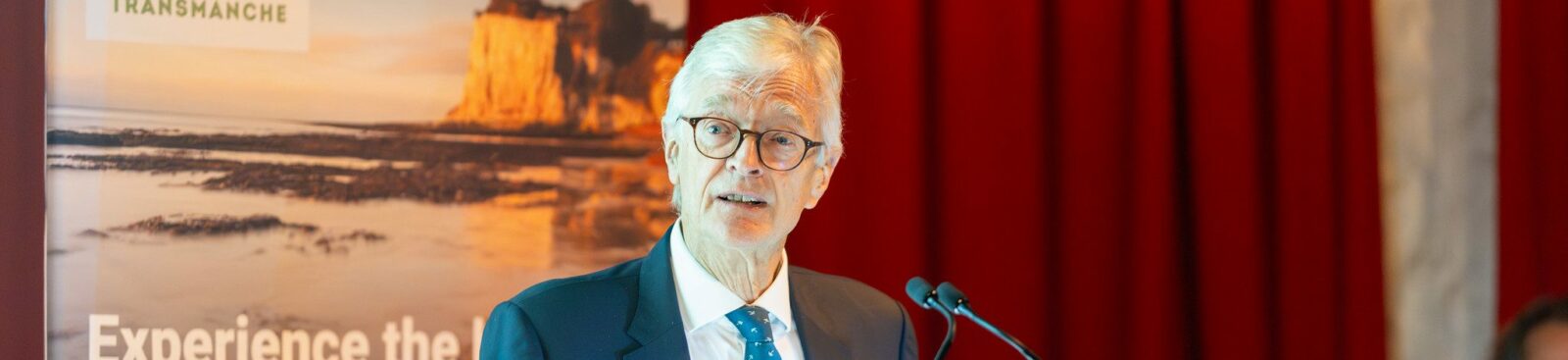
Discours de Nick Crane au Festival du Geopark Transmanche 2025
Château de Douvres, 7 novembre 2025
Les Géoparcs mondiaux de l’UNESCO nous offrent un regard neuf sur le monde. Avec émerveillement.
Chaque Géoparc est un site ou un paysage d’importance géologique internationale, géré pour protéger la nature, transmettre le savoir et favoriser un développement durable.
On pourrait penser que ces principes — protection, éducation, développement durable — devraient s’appliquer à chaque coin de la planète. Après tout, la Terre est entièrement géologique.
Aujourd’hui, il n’existe que 229 Géoparcs dans le monde, chacun étant un véritable joyau, un cristal étincelant, un symbole d’espoir et d’ambition. Et aucun d’eux ne s’étend sur deux pays reliés par la mer.
Le Géoparc Transmanche de l’UNESCO sera donc une première mondiale.
À la base de ce projet, il y a une logique géologique simple et magnifique : la craie qui relie les Kent Downs au Parc naturel régional des Caps et Marais d’Opale.
Ce Géoparc représente une richesse immense : pour l’éducation, la nature, le tourisme, l’économie, la compréhension internationale… et pour repositionner la Manche comme un espace central d’un avenir partagé.
En tant que géographe, présentateur et auteur sur les paysages, je suis enthousiasmé par la vision et les bénéfices concrets que ce Géoparc apportera aux communautés des deux rives.
Le Kent Downs et les PNR français ont beaucoup en commun : la mise en valeur de la campagne, la protection de la beauté naturelle, la préservation du patrimoine et le développement durable.
Les relier, c’est traverser l’une des voies maritimes les plus fréquentées au monde. Mais cette mer est bien plus qu’un simple couloir d’eau salée : c’est un ancien lieu de pêche, un écosystème marin crucial et un véritable théâtre de topographie côtière, des petites baies et plages aux falaises majestueuses et aux rivières à marée.
Cette étendue de 34 km a toujours été un regard tourné vers l’avenir. Par ces détroits sont passés les premiers agriculteurs, les chevaux et les roues, les légions romaines, les premiers chrétiens, les Anglo-Saxons, les premières voitures… et même les premiers croissants.
Chaque fois que je me tiens sur les falaises blanches de Douvres, face à celles de Cap Blanc Nez, j’ai l’impression d’être au-dessus d’un gigantesque réseau de fibres optiques géologiques, vibrant d’idées et de connexions entre les deux rives.