« Un paysage remarquable » – article du Dr Stephen Scoffham – Membre du Cabinet pour le Climat, l’Environnement et la Biodiversité
11 novembre 2025
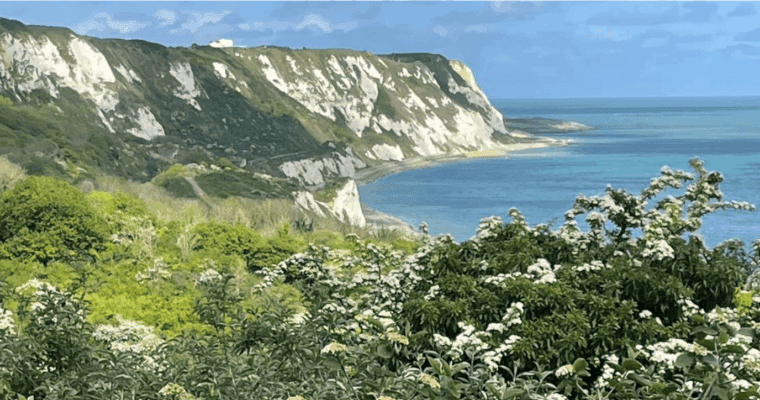
Les collines crayeuses qui s’étendent sur plus de 100 km à travers le Kent forment un paysage remarquable et particulièrement singulier. Les roches qui se trouvent sous la surface ont profondément influencé presque tous les aspects de l’écologie et de l’implantation humaine dans la région. Autrefois fortement boisée, la terre fut progressivement défrichée et peuplée entre le VIIᵉ et le XIVᵉ siècle. Le réseau actuel de routes, de champs, de paroisses, de bois et de fermes a été façonné par les besoins de ces premiers habitants. En conséquence, le paysage que nous voyons aujourd’hui est en lui-même un véritable document historique, complexe et riche en détails. Cependant, comme pour beaucoup de textes anciens, il doit être interprété.
Il y a quelques années, je suis tombé sur un ouvrage considéré comme une référence sur le paysage du Kent. Continuity and Colonization d’Alan Everett (Leicester University Press, 1986) retrace en détail l’évolution de l’occupation humaine dans le Kent et l’interaction entre les hommes et l’environnement. Everett recompose l’histoire du passé à partir des réseaux de routes, de chemins et des limites de paroisses figurant sur les cartes. Le lien entre les sols pauvres de la craie et les bois non cultivés est un thème récurrent. Il analyse l’évolution des pratiques agricoles et cite de nombreux chartes historiques. Les toponymes sont particulièrement importants et il les examine avec minutie.
J’ai été fasciné par l’histoire du district de Folkestone & Hythe. Par exemple, pourquoi les limites de paroisses dans les collines sont-elles souvent irrégulières et imbriquées comme les pièces d’un puzzle ? La réponse semble être que, autrefois, la forêt était subdivisée de manière à attribuer à chaque paroisse ou groupe de fermes une part soigneusement proportionnée de bois. Cela explique aussi pourquoi, à certains endroits, plusieurs paroisses se rejoignent en un même point, afin que chacune ait un accès raisonnable aux ressources. La relation entre les limites de paroisses et les fermes est également significative : ces dernières se trouvent souvent à la lisière des paroisses car elles marquaient alors le bord de la forêt.
Les églises constituent peut-être l’un des éléments les plus remarquables du paysage. Les églises perchées sur les collines, nombreuses dans le downland, sont particulièrement intéressantes car elles ont probablement été établies pour servir de points de repère aux bergers dans un paysage fortement boisé. Everett explique également que, bien que la plupart des églises du Kent aient été reconstruites après la conquête normande, un nombre significatif d’entre elles ont été fondées à des emplacements datant de l’époque jute (VIIᵉ siècle), de la période romaine, voire plus tôt. Il s’interroge aussi sur l’importance des puits sacrés et des sources, autrefois réputés pour leurs vertus curatives et associés à des cultes de fertilité ou au culte des esprits féminins de l’eau. Le fait que les églises situées près de sources à Folkestone et à Lyminge soient dédiées à des saintes femmes (Eanswythe et Ethelburga) pourrait indiquer une tradition préchrétienne.
Les noms de lieux constituent un autre sujet captivant. Beaucoup de toponymes du downland témoignent de terres défrichées dans l’ancienne forêt ou le wald. Cela apparaît sous différentes formes locales, comme wold (Womenswold), walt (Waltham) ou wheel (Wheelbarrow Town), tandis que Acrise (bosquet de chênes) et Wootton (ferme boisée) rappellent le défrichement des bois. De plus, les lodges ou fermes des premiers habitants se retrouvent dans les noms de hameaux comme Exted, Elmstead, Maxted et Palmstead. Quelques toponymes font référence à d’anciennes voies, telles que Stone Street et Pilgrims’ Way, mais dans un territoire initialement composé de fermes isolées, la plupart des exploitations étaient nommées d’après des animaux, des oiseaux, des plantes ou les arbres de la forêt comme le hêtre, le chêne et l’orme.
Les noms de lieux apportent aussi des indices sur les pratiques agricoles et l’économie rurale. Par exemple, un ensemble de toponymes autour de Swingfield (champ de porcs) sur la crête des collines au nord de Folkestone indique que la zone servait autrefois à l’élevage de porcs. Certains noms font directement référence aux bœufs, comme Oxenden Wood, tandis que les bassins ou abreuvoirs nécessaires au bétail laitier expliquent des noms comme Sole Street. Par ailleurs, de nombreuses parties de la forêt ancienne étaient gérées par des coupes régulières ou des récoltes cycliques. Cette pratique traditionnelle, consistant à couper les arbres pour les laisser repousser, est rappelée dans des noms contenant copse ou spring, et contribue à l’abondance des jacinthes et des anémones, aujourd’hui caractéristiques des bois du Kent.
Everett est attentif à la topographie du downland autant qu’à l’histoire de son peuplement. Il célèbre les bois tranquilles, les vallons étroits, les fermes isolées et les églises solitaires. Le pays crayeux du Kent est, dit-il, « tout à fait différent de n’importe quelle autre région d’Angleterre ». Ce qui le rend si particulier, c’est l’ampleur et la densité de ses bois, reposant sur des sols pauvres et s’étendant sur une bande quasiment continue à travers toute la région.
Le paysage paisible, silencieux et largement isolé que décrivait Everett il y a une quarantaine d’années a beaucoup changé. Pourtant, la région reste accessible uniquement par de petites routes et, à l’exception de Hawkinge, en périphérie de Folkestone, elle échappe toujours à l’urbanisation. L’analyse minutieuse d’Everett éclaire de manière fascinante la façon dont les différents éléments du paysage du downland ont évolué au fil des siècles, de la même manière, pour reprendre ses mots, que « l’expérience d’une vie s’inscrit dans les lignes du visage humain ».
En novembre, le Kent Downs National Landscape et le Parc naturel régional des Caps et Marais d’Opale ont soumis une candidature à l’UNESCO pour créer un Cross-Channel Geopark transmanche couvrant ces deux paysages et le Détroit du Pas de Calais. Si elle aboutit, cette initiative offrira une reconnaissance internationale à cette région exceptionnelle, à sa géologie et à son histoire culturelle. Nous avons hérité d’un patrimoine unique de nos ancêtres et il mérite d’être préservé et célébré.
Articles populaires
GeoAdventures – découvrez les merveilles du Geopark mondial Transmanche !
GeoAdventures est un festival dynamique de neuf mois célébrant l’aspirant géoparc mondial…
Explorez le Geopark Transmanche avec notre carte géotouristique
Votre guide du Geopark Transmanche : téléchargez gratuitement la carte géotouristique et…