Our Geological Story
The Cross-Channel Geopark immerses us in a geological history spanning 400 million years. In the Devonian and Carboniferous periods, the region was emerging, forming a mountain range where life abounded, as evidenced by the fossils discovered in the Marquise Quarry Basin.
Over time, this range eroded, and during the Jurassic period, shallow marine environments took over, giving rise to stunning sandstone and clay cliffs, such as those at Cap Gris Nez.
During the Cretaceous period, a greenhouse effect submerged Europe under the Chalk Sea, forming vast chalk hills. In the Geopark, these hills stretch from the edge of London to the chalk hills in the Boulonnais, only interrupted by the Channel, where they form the famous white cliffs of Dover and the Cap Blanc-Nez (this Chalk still connects us underneath the sea!). Composed of the shells of microscopic plankton (such as coccolithophores), chalk is the rock that connects our two regions and forms iconic features of the landscape, illustrating the deep connection between land and sea, as well as between two nations.
The Formation of the English Channel
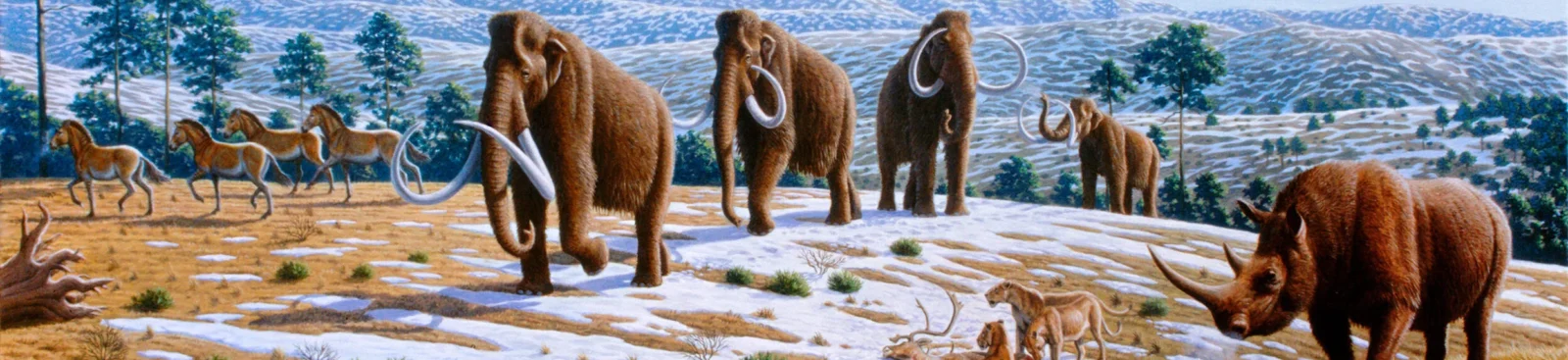
One of the most significant events in the geological history of the Geopark took place about 450,000 years ago, towards the end of the Anglian Ice Age, a time when the Geopark was the coldest it has ever been. The Geopark area sat just south of the furthest point that the glaciers and ice sheet reached. A huge glacial lake had formed between the ice to the north, land masses to the east and west, and a ridge of chalk hills forming a dam to the south. The chalk hills acted as a land bridge that humans and animals could move across.
Eventually, the lake burst through the land bridge completely (as it did so it carved out 80m deep plunge pools in the solid rock that is now the seafloor!). This massive flood formed what we now know as the Channel, separating Britain and Europe. The submerged chalk ridge beneath the Channel is a reminder of this ancient land bridge, offering a unique geological link between the two coasts.
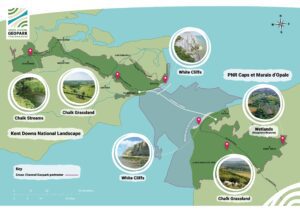
Map of the Geopark
This map shows the Cross-Channel Geopark, stretching from southern England to northern France. It highlights key natural features like chalk streams, grasslands, wetlands, and the iconic white cliffs. The Geopark connects these special places across borders, celebrating a shared landscape, geology, and story.
Geological Overview
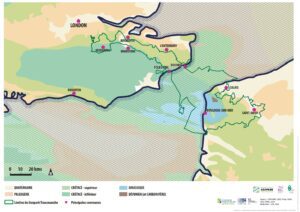
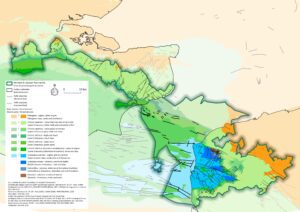
Cross-Channel Geopark Boundary
Devonian (419 – 359 million years ago)
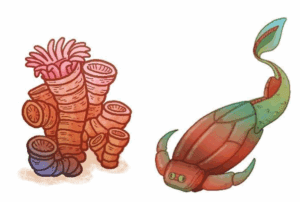
During the Devonian period (419 to 359 million years ago), the area that is now the Geopark was completely submerged. The tropical climate favoured the development of marine biodiversity. Around the middle of the Devonian, extensive reef environments formed, where fish, corals, molluscs, algae, and sponges coexisted. These organisms left fossil traces that are preserved in the limestone rocks still present today in France. These fossils allow us to reconstruct ancient marine habitats and provide evidence of the evolution of ecosystems during this period.
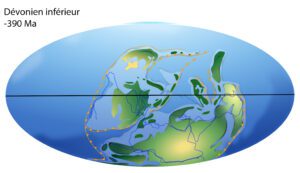
© F. Thirion after C. Scotese — Devonian
Carboniferous (359 – 299 million years ago)
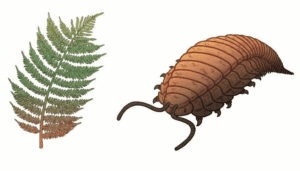
During the Carboniferous period (359 to 299 million years ago), the climate remained tropical. The landscape of the Cross-Channel Geopark underwent major upheaval. Initially underwater, it was gradually pushed up as part of a massive mountain-building event, forming a range comparable to the present-day Himalayas. By the end of the Carboniferous, this range was fully formed, and the Geopark region was no longer underwater. At the foot of these mountains, vast swampy forests with lush vegetation thrived, leading to the formation of coal that was later exploited in the Geopark’s subsoil (at Marquise).
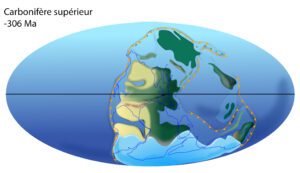
Paleogeographic map: © F. Thirion after C. Scotese — Carboniferous
Jurassic (199.5 – 145.5 million years ago)
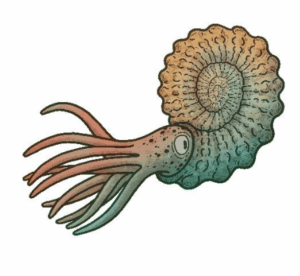
Between the end of the Carboniferous and the Jurassic period (from 199.5 to 145.5 million years ago), the mountain chain underwent intense erosion, and the territory of the Geopark became flattened. During the Jurassic, as the Atlantic Ocean began to open, the area was periodically flooded by the sea. The rocks found in the Boulonnais, in France, testify to this: sandstones, limestones, and clays, rich in marine fossils (ammonites, marine reptiles, fish, bivalve molluscs, and more). They reflect shallow environments where waves and tides left their marks (ripples, dunes, and more).
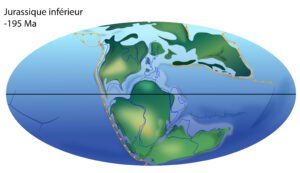
Paleogeographic map: © F. Thirion after C. Scotese — Jurassic
Cretaceous (145 – 65.5 million years ago)
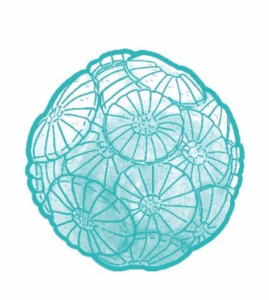
During the Early Cretaceous (145 to 100 million years ago), a significant greenhouse effect caused global temperatures to rise above present-day levels, along with a substantial increase in sea levels. In the second half (100 to 65.5 million years ago), the sea covered much of Europe. This sea is known as the Chalk Sea. Life flourished in this sea, both in the waters (mosasaurs, sharks, ammonites, nautiluses, and more) and on the seafloor (sponges, bivalves, sea urchins, and more).
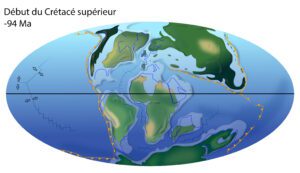
Paleogeographic map: © F. Thirion after C. Scotese — Cretaceous
Quaternary (Last 2.6 million years)
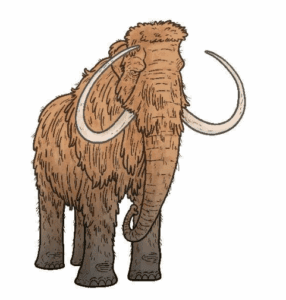
The Quaternary is the most recent period in Earth’s history, covering the last 2.6 million years. It is marked by the emergence of the genus Homo. This period was also characterised by climatic instability, with alternating cold periods, known as glacial phases, and warmer periods, called interglacials. These climate variations strongly shaped the landscape of the Cross-Channel Geopark: the opening of the Strait of Dover, the formation of coastal landscapes, the courses of rivers and their valleys, and the settlement of humans in the region.
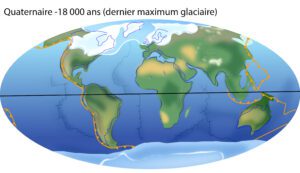
Paleogeographic map: © F. Thirion after C. Scotese — Quaternary