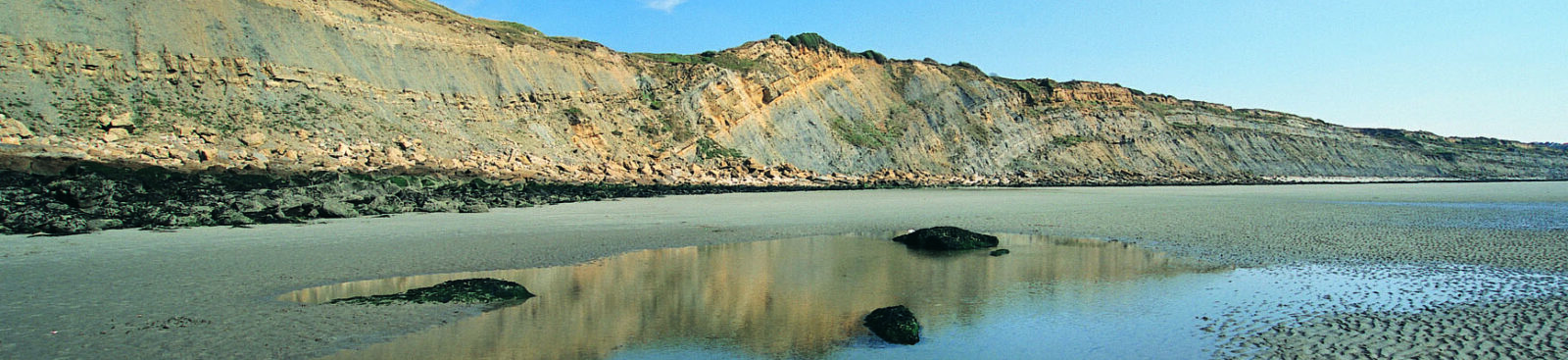
What is a UNESCO Global Geopark?
A UNESCO Global Geopark is a designation awarded by UNESCO to an area that is internationally recognised for its outstanding geological heritage. These areas are managed through a holistic approach that combines protection, education, and sustainable development. This designation highlights an ambitious vision, supported by local partners and communities, including elected representatives, organisations, and residents.
While a UNESCO Global Geopark must demonstrate the international importance of its geological heritage, its main aim is to showcase the links between geology and all other aspects of natural, cultural, and intangible heritage.
It seeks to reconnect humanity with the planet at every level, revealing how geology has shaped our lives and societies over the past 4.6 billion years.
Achieving this designation means committing to sharing local history, skills and landscapes, helping people understand:
-
How our landscapes were formed
-
Why local biodiversity is unique
-
Why certain stones are used in buildings and construction
Understanding landscapes through geology
Geology is not just about fossils. It shapes hills, rivers, coastlines, and soils. It tells the story of the past and helps us better understand the present.
A Geopark helps everyone to read this story — to travel back through time and discover what lies beneath our feet… to better understand what lies before our eyes.
The core missions of a UNESCO Global Geopark
A Geopark has four main missions:
-
To promote and protect geological heritage through sustainable tourism
-
To raise awareness, train, and educate visitors and local communities
-
To involve local stakeholders and communities in shaping activities and projects
-
To strengthen scientific knowledge of the geological heritage
These actions begin even before official designation, as UNESCO requires that an area operate as a Geopark for at least one year before submitting a formal application.
A growing global network
A Geopark is first and foremost a network, whose members commit to working together and sharing experience. All Geoparks are part of the Global Geoparks Network, which meets every two years to exchange ideas, cooperate, and strengthen the international recognition of geological heritage.
Today, more than 229 Geoparks in 50 countries form a dynamic network supported by UNESCO. Each Geopark helps protect and celebrate geological heritage while promoting sustainable and responsible tourism.
Why a Cross-Channel Geopark?
Imagine… more than 8,000 years ago, you could have walked across what is now the English Channel. France and England were once connected by a vast chalk plateau, which explains why landscapes and geology remain so similar on both sides today.
The creation of a Cross-Channel Geopark, bringing together the Parc naturel régional des Caps et Marais d’Opale and the Kent Downs National Landscape, would support concrete actions to promote and protect shared geological heritage.
It would be a world first: a cross-border Geopark separated by the sea. The project would also include the marine area of the Strait of Dover (Pas-de-Calais), creating a Geopark unique in Europe.