The Best Viewpoints in the Cross-Channel Geopark
April 30, 2026
Across the English Channel lies one continuous landscape written in chalk, shaped over millions of years and shared between two countries. In England it forms the sweeping ridges and valleys of the Kent Downs National Landscape. In northern France it rises again in the Parc naturel régional des Caps et Marais d’Opale, where cliffs, hills and valleys carry the same geological story.
This is a landscape defined by height and horizon. High points open out across farmland and woodland. Valleys cut through the chalk and guide long views across the land. Coastal edges drop into sea and sky. On clear days, the wider landscape feels visually connected, even with the Channel in between.
Across these viewpoints, the same story repeats in different forms. Chalk shaped by time, softened by vegetation and expressed through ridges, valleys and open skylines across the Geopark.
Top 10 viewpoints across the Geopark (west to east)
-
Ide Hill
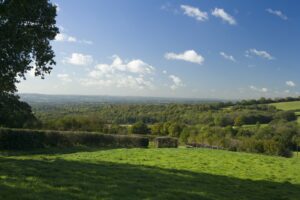
Ide Hill sits within the Kent Downs and offers one of the most expansive inland viewpoints in the Geopark landscape. From its elevated position, the Kent Weald stretches across the horizon in a patchwork of fields and woodlands. The surrounding Greensand Ridge supports semi-natural woodland on steep slopes, where the landscape shifts between chalk and greensand geology. Although the 1987 storm reduced much of the tree cover, the woodland has regenerated into a rich and varied habitat. Today it forms part of a wider connected landscape, known for deer, woodland birds and seasonal plant life.
-
Blue Bell Hill
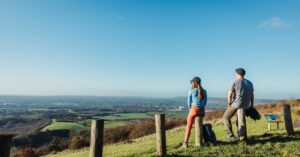
Blue Bell Hill rises above the Medway Valley where the landscape opens into wide river corridors and gently sloping farmland. Chalk grassland supports rare plants and insects, while the North Downs Way passes through the reserve. From here, open views extend across the valley and surrounding countryside in broad layers of land and sky, shaped by the movement of the river below.
-
Wye Downs
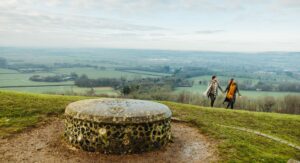
Wye Downs features dramatic chalk downland, mixed woodland and scrub grassland, creating a rich habitat for wildlife. From the Wye Crown chalk hill figure, views stretch across the Kent Downs. The landscape leads into the Devil’s Kneading Trough, a dry bowl-shaped valley formed through long geological processes and often described as one of Kent’s most distinctive natural features. On clear days, the view reaches towards Rye, Romney Marsh, Hastings and Dungeness.
-
Farthing Common
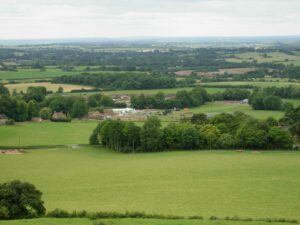
Farthing Common is one of the highest points in the Kent Downs. From here, views extend towards the High Weald National Landscape and surrounding countryside. Located 10km north of Hythe and Folkestone, it sits at a junction of paths and rural roads. From the surrounding tracks along the North Downs Way, wide views open across farmland and scattered villages, with long horizons shifting through changing light and weather.
-
Abbot’s Cliff Sound Mirror
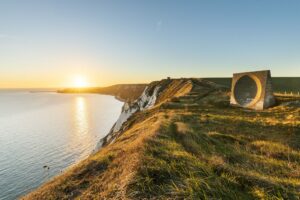
Abbot’s Cliff sits along the heritage coastline where chalk cliffs meet the sea. The viewpoint combines coastal scenery, historic structures and open landscapes shaped by erosion and exposure. From the cliff edge, long views extend along the White Cliffs of Dover towards Folkestone and further stretches of coastline. The sound mirror, built as an early warning system during the First World War, remains a striking feature within the coastal landscape.
-
Wavrans-sur-l’Aa
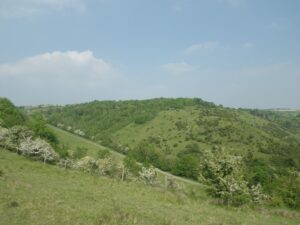
The hills of Wavrans-sur-l’Aa overlook the Aa Valley, where chalk has been carved into steep slopes, meadow and woodland. The landscape is shaped by erosion and groundwater, forming a layered valley system where grassland, trees and escarpments sit in close contrast. The valley floor and upper slopes shift in character across short distances, and the site is also known for migratory bird activity moving across the valley.
-
Chapelle deGuémy
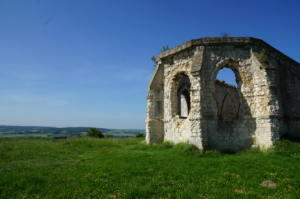
Chapelle de Guémy stands on elevated ground above the Hem Valley within the wider chalk landscape. Built at the end of the 15th century in a Flamboyant Gothic style, it sits within a setting of meadows and gentle slopes that open out into the surrounding countryside. From its heights, the landscape unfolds across Artois towards the coastal plain, where fields and ridgelines form long uninterrupted views across the Geopark terrain.
-
Mont de Couple
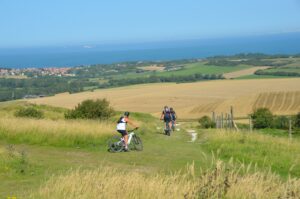
Mont de Couple rises above inland chalk landscapes, offering wide views across farmland, ridgelines and distant coastal edges. The slopes reveal the transition between inland countryside and coastal influence, where open fields gradually give way to wider horizons. It is a key point for reading the structure of the Geopark landscape in a single view.
-
Mont Pelé and Mont Hulin
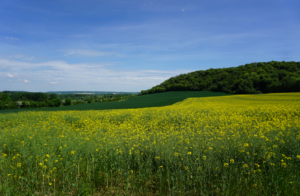
Mont Pelé and Mont Hulin form twin high points in the Boulonnais landscape. Once shaped by chalk extraction, the slopes are now softened by vegetation, grassland and farmland that have gradually returned to the land. The surrounding countryside opens into wide rural views, where layered hills and fields stretch into the distance. On clear days, the English coastline appears on the horizon, marking the wider connection across the Channel.
-
Écault Dunes
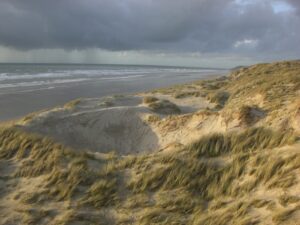
Écault Dunes sit along the coastal edge of the Geopark where sand, woodland and sea meet. The landscape is shaped by wind and tide, creating shifting forms and open coastal space. From the dune tops, the view opens into the English Channel, where changing light and weather define a constantly evolving seascape along the edge of the Geopark.
Popular articles
Explore the Cross-Channel Geopark with Our Geotouristic Map
Your guide to the Cross-Channel Geopark: download the free Geotouristic Map and…
Your guide to exploring the Cross-Channel Geopark with interpretation panels
Explore the Cross-Channel Geopark like never before with new interpretation panels that…
Geopoetry and the memory of a stone
Discover how Geopoetry turns stones into stories, connecting people, nature, and the…