Chalk Hill Figures of the Cross-Channel Geopark
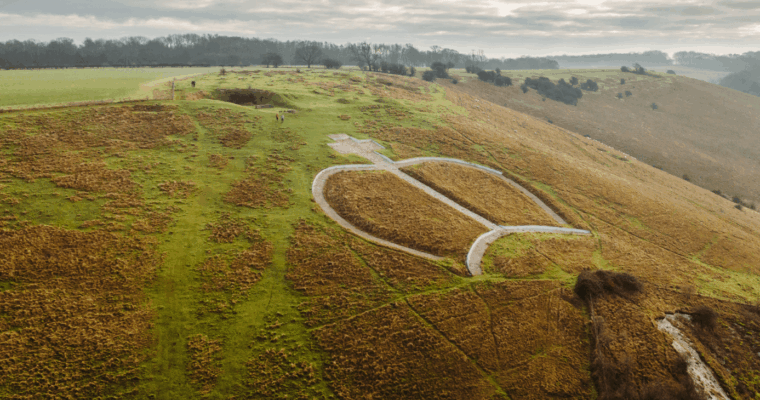
June 22, 2026
The dramatic chalk landscapes of the Cross-Channel Geopark span southern England and northern France, formed from the same ancient seabed and shaped over millions of years. Across this shared landscape, chalk hills, cliffs and downlands create a distinctive terrain that links both sides of the Channel through geology, biodiversity and cultural heritage.
One of the most striking human expressions of these chalk landscapes is the creation of hill figures.
These large-scale geoglyphs are carved into hillsides by removing soil to reveal the bright white chalk beneath. Visible from long distances, they connect geology, cultural identity and collective memory across chalk landscapes.
What are hill figures?
Hill figures, also known as geoglyphs, are large designs created on slopes by exposing chalk bedrock beneath the turf. They are most commonly found in areas where soft chalk geology and steep hillsides make them possible.
Across chalk landscapes in southern England and parts of northern Europe, these figures include animals, crosses, memorial symbols and abstract designs. Some are very old, while others were created in more recent centuries to mark events or express local identity.
One of the most famous examples is the prehistoric Uffington White Horse in Oxfordshire, believed to be around 3,000 years old.
Chalk Hill Figures in the Cross-Channel Geopark
Within the Cross-Channel Geopark, chalk landscapes provide a shared canvas across England and France. The underlying geology is continuous, but it has inspired a variety of cultural expressions over time.
On the English chalk downlands, hill figures are a particularly visible tradition. These large hillside carvings were created across different periods, often linked to celebration, remembrance and community identity. Their presence reflects both the visibility of the chalk slopes and a long tradition of shaping open landscapes into symbolic forms.
Across the Channel in northern France, the same chalk geology continues in the form of rolling plateaux, valleys and coastal cliffs. Here too, people have long lived with and shaped the chalk landscape, expressing identity and memory through monuments, village landmarks and built heritage that sit within and alongside the natural terrain.
Together, these varied expressions form part of a shared cultural relationship with chalk landscapes across the Cross-Channel Geopark, where the same geology inspires different but connected ways of marking place, memory and meaning.
Wye Memorial Crown
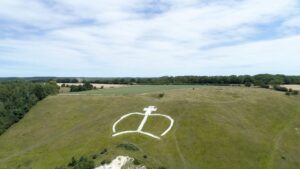
Created in 1902 to celebrate the coronation of King Edward VII, the Wye Memorial Crown sits high above the village of Wye beneath the North Downs Way.
The idea originated from Wye Agricultural College, and the crown was famously illuminated with bonfires during the coronation celebrations. During the Second World War, the landmark was concealed to prevent it being used as a navigational point by enemy aircraft.
Today, the crown remains one of Kent’s most distinctive chalk landmarks, with panoramic views across the surrounding countryside.
Shoreham Memorial Cross
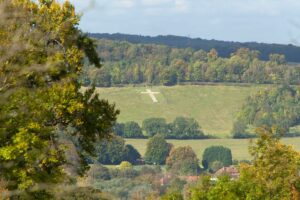
The Shoreham Memorial Cross was created after the First World War to commemorate local men lost during the conflict. The project was led by Samuel Cheeseman, who lost both of his sons during the war.
Completed in 1921, the cross overlooks Shoreham village and became an important site for annual remembrance gatherings. Public footpaths now allow visitors to walk up to the hillside landmark and enjoy views across the Darent Valley.
Lenham Memorial Cross
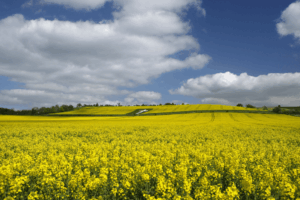
Positioned above the village of Lenham, this memorial cross commemorates lives lost during both World Wars.
Constructed in 1922 and designed by the local school headmaster, the landmark became a focal point for remembrance ceremonies throughout the twentieth century. During the Second World War, the cross was temporarily covered before being restored in 1945.
Historic England officially recognised the site as both a National Monument and War Memorial in 2017.
Folkestone White Horse
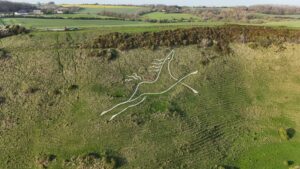
Completed in 2003, the Folkestone White Horse is the youngest hill figure in Britain. Overlooking Folkestone and the Channel Tunnel terminal, the landmark was designed by local artist Charlie Newington and inspired by the ancient Uffington White Horse.
Unlike traditional hill figures carved directly into the hillside, the Folkestone horse was created using chalk blocks placed onto the slope.
Its construction sparked debate due to the ecological importance of the surrounding chalk grassland, now protected as both a Site of Special Scientific Interest (SSSI) and Special Area of Conservation (SAC).
Today, the white horse has become an iconic symbol of Folkestone and the wider Cross-Channel landscape.
Geology and Cultural Heritage
The chalk hill figures of the Cross-Channel Geopark highlight how geology shapes cultural identity and local heritage. The region’s chalk bedrock has influenced settlement, farming, biodiversity and artistic expression for centuries.
These landmarks are symbols of memory, place and the enduring relationship between people and landscape.
Visiting Responsibly
Many hill figures are located within environmentally sensitive chalk grassland habitats that support rare wildlife and plant species.
When visiting:
- Stay on marked footpaths
- Avoid damaging chalk grassland
- Respect farmland and livestock
- Leave no trace
By helping protect these landscapes, visitors can support the conservation of both natural and cultural heritage across the Cross-Channel Geopark.
Popular articles
Explore the Cross-Channel Geopark with Our Geotouristic Map
Your guide to the Cross-Channel Geopark: download the free Geotouristic Map and…
The Best Viewpoints in the Cross-Channel Geopark
Discover the most spectacular viewpoints across the Cross-Channel Geopark, from the Kent…
Your guide to exploring the Cross-Channel Geopark with interpretation panels
Explore the Cross-Channel Geopark like never before with new interpretation panels that…