Gertrude Ederle the woman who swam the Channel
August 4, 2026
There are plenty of ways to cross the Channel. You can take the ferry, catch the train or, if you’re feeling particularly brave, swim.
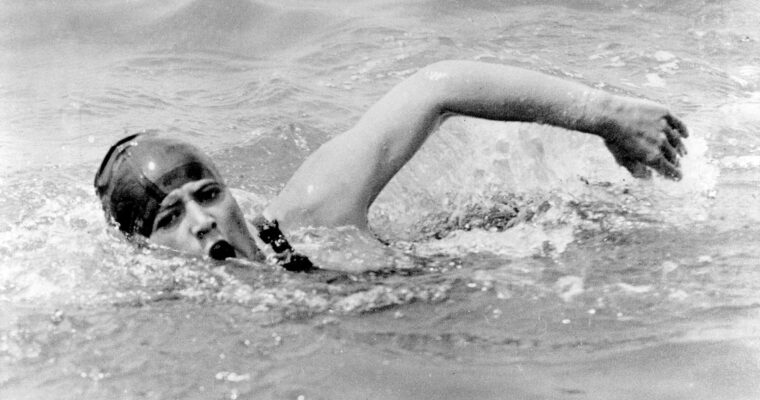
On 6 August 1926, 19 year old Gertrude Ederle chose to swim, stepping into the sea at Cap Gris-Nez in northern France.
She was an Olympic swimmer and about to attempt something no woman had done before. Fourteen hours and 39 minutes later, she reached the Kent coast at Kingsdown.
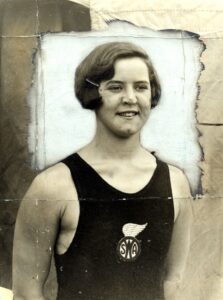
A century on, Ederle is still remembered as the Queen of the Waves. Her remarkable crossing made her the first woman to swim the English Channel and saw her break the existing record in the process.
To mark 100 years since her historic swim, we’re taking a closer look at Ederle’s achievement, the challenge of crossing the Channel and the landscape she travelled through along the way.
Today, Cap Gris-Nez and the Kent coast sit within the Cross-Channel Geopark Transmanche, alongside the marine area between them. Ederle travelled through all three in one very long day.
Queen of the Waves
© Dover Museum
At its narrowest point, the Channel is around 21 miles across. But swimming it has never been as simple as going from one coast to the other. Strong tides and currents can carry swimmers far from a direct route, while weather and sea conditions can make an already demanding crossing even harder.
Ederle set off shortly after 7am. Her support boat travelled alongside her, with her sister Margaret on board playing some of her favourite records. The crew supplied her with food and drinks as she swam, while keeping a close eye on the changing conditions.
As the afternoon went on, the weather changed and the sea became rougher. The tides were also carrying Ederle away from Dover. Rather than fighting the current, her team changed course and allowed it to carry her northwards towards the Kent coast.
The sea had more in store for her too. At one point, Ederle had to swim through a mass of red jellyfish and was stung as she continued on her way.
It meant Ederle travelled considerably further, around 35 miles, than the distance between the two shores. As the storm worsened, visibility became extremely poor, making it difficult for her to see where she was heading. People gathered along the Kent coast and lit fires on the beach to help guide her towards shore.
After more than 14 hours in the water, she finally reached Kingsdown at 9.48pm. Around 4,000 people were waiting on the beach to see her arrive.
Ederle had become the first woman to swim the English Channel. She had also broken the existing record, completing the crossing almost two hours faster than the previous best time set by Argentine swimmer Enrique Tirabocchi in 1923.
Her achievement made international headlines. In New York, millions of people turned out to welcome her home with a ticker tape parade, one of the biggest celebrations ever held for a female athlete. Her success also helped inspire thousands of women to learn to swim and take up the sport.
But Ederle’s journey also gives us a chance to look beneath the surface.
What lies beneath the Channel?
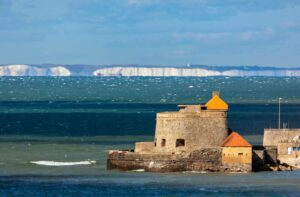
From the coast, the Channel can seem like a simple stretch of water separating Britain and France. Yet beneath it lies a much older geological history.
Millions of years ago, a warm, shallow sea covered much of this part of Europe. Tiny marine organisms lived in its waters, and their remains gradually accumulated on the seabed. Over immense stretches of time, these deposits became chalk.
Today, chalk forms some of the most recognisable landscapes on both sides of the Channel. In Kent, it gives us the White Cliffs of Dover and the chalk hills of the Kent Downs. Across the water, the same chalk can be seen at Cap Blanc Nez and in the surrounding landscapes of northern France. It also continues beneath the Channel, connecting the geology on either side.
The Channel itself came much later. Around 450,000 years ago, Britain and Europe were connected by a ridge of chalk hills. A huge glacial lake had formed to the north, and when its waters broke through the ridge, a Megaflood carved through the landscape. Over time, this helped create the Channel we know today.
And even Cap Gris-Nez, where Ederle began her swim, tells a different part of the geological story. Its cliffs are around 150 million years old and formed during the Jurassic period, when this area was covered by a shallow sea. The rocks here are much older than the chalk landscapes found further along the French coast and in Kent.
A Channel between two shores
For thousands of years, the Channel has been a route between Britain and continental Europe. People have travelled across it, ships have carried goods between its shores and wildlife has moved through its waters.
Nearly a century later, you can still stand on the Kent coast and look across towards France, or stand on the French coast and look back towards Kent.
You can also find out more about Ederle’s story at Dover Museum, where the Queen of the Waves exhibition runs from 6 August to 7 November 2026 marking 100 years since Ederle’s historic crossing. The free exhibition brings together photographs, objects and memorabilia celebrating her achievement and lasting influence on women’s sport and open water swimming.
Popular articles
Explore the Cross-Channel Geopark with Our Geotouristic Map
Your guide to the Cross-Channel Geopark: download the free Geotouristic Map and…
The Best Viewpoints in the Cross-Channel Geopark
Discover the most spectacular viewpoints across the Cross-Channel Geopark, from the Kent…
Your guide to exploring the Cross-Channel Geopark with interpretation panels
Explore the Cross-Channel Geopark like never before with new interpretation panels that…